Pages

Showing posts with label how-to. Show all posts

Monday, June 20, 2016

How To: Avoid Feeling Homesick

"Don't you miss your family? Aren't you homesick?" These are in the top 10 of questions everyone over here asks me, and while it's nice to know someone is concerned about my well-being, it makes me wonder if I'm the odd one out for not being homesick. This isn't new; I've been wondering about this same topic almost since I first arrived in Korea.


"Now, in the “Counseling Booklet” that Epik has provided me with, they give a very thorough explanation of the various phases of culture shock. The first phase? The “Honeymoon Phase”. The booklet describes this time as “the period just after arrival in a new country…everything appears to be exciting and novel. The individual rarely finds any problems with the new country and may feel euphoric. Many people believe that the new country is flawless.” Ever since I read that passage last week, it’s been floating around in the back of my head. Is my love affair with Korea going to fade into the more negative aspects of culture shock? Am I just romanticising things that, in a few months, I will realize I secretly hate?"


Well, I'm coming up on three years, and while the honeymoon phase is over, I can honestly say that I don't often feel homesick, and when I do, it's not crushing. Instead of ruining my day, it can be an almost enjoyable melancholy or nostalgia. Anyways, since I know that homesickness is a problem that many people deal with, I thought I'd write about my own experiences and how I fend off homesickness. Now, I can't say if any of these will be helpful for you, or even possible, but this is how I, personally, stay so positive in Korea.

Reason the first: Seattle Sucks


My life since middle school has been a long string of getting out of wherever I was. Getting out of middle school, getting out of high school, out of my hometown, and finally out of Seattle, where I went to college. Why a person might not enjoy life in a small town is pretty obvious. With a graduating class of 100, it didn't leave many options as far as friends went, and with a dwindling population and zero job prospects outside of barista, drug dealer, or starving artist (or the triple threat combo) ...well, I didn't waste any time shipping my own self off to college.

After graduating from the University of Washington with a BA in English and the newly kindled desire to teach, I made the big dumb mistake of taking a year off to "rest". Seeing as neither me nor my parents are independently wealthy, I couldn't just sit around for a year reading Marvel comics and drinking coffee, as much as that appealed to me. I needed a job, and with a degree in English from a great school, I was able to get a totally relevant job in the service industry. By relevant I mean totally irrelevant and by service industry I mean a tiny cafe that made crepes. As I was one of the only employees not in school at the time, I ended up going months without a full day off, working 50-60 hours a week, and still barely having the money to cover rent and life expenses. Minimum wage is just so awesome like that.

But at least now I am a certified crepist. Wait...

I was, in a word, miserable. It doesn't help that the weather in Seattle shares most of its characteristics with a damp sock. Even when things are going well in your life, unless you really enjoy overcast gray weather, it's hard to stay positive during the interminably long Seattle winters. And springs. And falls. And sometimes it stays cloudy even though summer, because the other 9 months just weren't enough!

What I'm saying is, probably the biggest reason for my lack of homesickness is that...well...there honestly isn't much for me to miss about home. Yes, I miss my friends and family, but with things like Skype and Facebook and Kakaotalk and email, it's easy to stay in touch on a level that keeps me from feeling the distance. Maybe this isn't the best kind of advice to give, since it boils down to "hate your home" and I know that's not something that most people are going to be able to do. I guess I'm just lucky to have had such a terrible time before I moved.

Get Busy


As they say, idle hands are the devil's...instruments? Playground? Idle minds are the devil's gymnasium? Look, I'm no expert in old sayings but you get what I mean. I think one of the biggest challenges, especially when you first move to a new place, is keeping yourself busy. Everything is going fine, you're feeling good, and then suddenly the weekend comes and you're on your own for two whole days. Personally, I start to feel down in the dumps when I don't have a lot to do, no matter where I'm living, but I feel like this is something that really matters for people who are trying to live in a foreign country. It's easy to feel isolated, and if you're just sitting around in your tiny apartment, that isolation only intensifies. So, instead of spending the whole time laying on your bed watching the English language movie channel and moaning about how much you miss your family/Taco Bell/good cheese, get your butt outside and do something!

"But I don't know Korean!" 

No excuse! Just go for it! Want to order food? Just point at something and hope for the best. Ursula the seawitch had it right: never underestimate the importance of body language. When I first got to Korea I was limited to "Hello" and "Thank you" as far as speaking went, but I was still able to joke with a coworker about mosquitoes, entirely through sound effects and acting.

This bit of advice is harder to follow the smaller your town is. Life in the middle of Seoul is about as similar to life in the rural country village as my students are to actual humans. Which is to say, not at all. But hey, this country is tiny. Do some traveling! Explore your (albeit) tiny town! Take up a hobby. Join a gym and get super buff (then teach me your secrets). 

Mr. and Mrs. Brightside


Lastly, and this is advice for pretty much everyone in any type of situation, try to find the positive part of what's happening to you. Bad thing will happen. Annoying things will happen. That's to be expected. Taxi drivers will try to cheat you on your fare. Classes will be changed and cancelled with no notice. Your coworkers will be passive-aggressive. Your students will make you cry. That's normal, and it sucks.

But the way I see it, focusing ONLY on the things that suck just makes them seem bigger. I really like the way Simon, from the Eat Your Kimchi folks, puts it in a blog post about staying positive

"I could be upset about dealing with our landlord, buuuut I have a soft kitty here[...]I could be upset that a project I had been planning fell through, but look at that sunset. Once you realize that all things are of equal significance[...]then the playing field is levelled. Good experiences and bad experiences have the same weight, so why not put my energies into experiencing the positives?"

I've always hated the saying "it takes more muscles to frown than to smile" because a lot of time, it's utter BS. Sometimes it's hard to smile. Sometimes pipes burst or cars break down or things just Go Wrong for seemingly No Reason. There's nothing you can do about that. It already happened. The best thing to do is to find the part of your day that didn't suck. Was there one funny thing a student said? Did you eat the most delicious strawberry ever? Did your mom send a photo of her new poodle? Focus on that. It takes practice, but trust me, it works out better in the long run.

I think this kind of thinking is especially important when you're living in South Korea, and probably any foreign country. Sorry Korea, but you're pretty...racist? I hate to pull out the R card, so maybe we can stick to xenophobic? Unaware that there are other types of people out there and that's okay? Whatever you want to call it, it's hard to be the one different person in a sea of similarity. I never realized how diverse the US was until I moved to Korea. As an American over here, as any type of foreigner I'm sure, it's easy to feel victimized or singled out. Any negative experience can be viewed through the lens of "it happened to be because I'm not Korean."

Sometimes, that's true. Other times, it's not. All I ask is that you take a second to consider if the taxi driver didn't stop for you because he hates Americans, or if maybe he just didn't see you. And even if its the former, will knowing that somehow make you happier? Personally, I know it won't. Even if I have to lie to myself once in a while, I'd rather assume the best in order to feel better, instead of assuming the worst and getting bitter.


So go out and enjoy life. Experience things, and when you miss friends and family back home, go do something interesting so you'll have the best stories to tell them when you meet again. Why do you think I've had so many adventures?


Sunday, June 21, 2015

How To: Prepare for and Pass the Epik Interview

Before I get started, I want to make it clear that I'm not just going to tell you exactly what happened in my interview, because that doesn't seem fair. What I can do is tell you all the dumb things I wish I hadn't done and the useful things I wish I had done, in hopes that you will have a better time of it than I did.

First off, make sure Skype works on whatever computer you plan to be in front of during the interview. I know this seems obvious, but trust me on this one: check and double check so there won't be any unforeseen technical difficulties. You know what they say about people who assume.


Get it? GET IT??

In the same theme, unless you use Skype all the time and have somehow figured out a way to NOT act like a total spaz while talking through it, I'd suggest practicing a few times with a friend or family member until it feels a bit more normal and you're not constantly staring at your own face in the camera and wondering what you normally do with your hands. Hold two coffee cups if it helps.

Next, and this might sound obvious, plan what you want to say. I'm not saying you need to write a full speech word for word and memorize it, because that would be overkill, but I think it's a good idea to write down a few key points. Why do you want to teach? Why did you choose Korea? What do you know about Korea? How do you deal with culture shock? What are your thoughts on Dokdo?

Okay, that last one is probably a bad idea unless they specifically bring it up. I made the mistake of hubris; I assumed that, with my intimidating elocutionary skills, I'd do just fine. No need to prep here! Haha! Which of course led to my roommate having to use her mime skills to remind me that I love Korean music and understand Korean drinking culture. Seriously. Music and drinking, two of my favorite things in the world, and I could think of neither of them under pressure.

Lastly, as I've said before, don't panic. I'm pretty sure the interview is just to make sure you're a human being capable of English speech. Plus, at least in my case, the interviewer was super chill and super nice. Your EPIK recruiter is not your enemy. Be honest, explain why you want to teach, and odds are you'll be fine. And if not? Well, there are plenty of other fish in the sea. EPIK is not the only option, so seriously, don't stress.

I mean, if they let a weirdo like me in, there's hope for just about anyone, right?

Wednesday, March 4, 2015

EPIK Help Part 1: How to Fill Out the Epik Application

The snow is melting, yellow dust has begun to float in from China, students are shedding their winter padding coats, and you know what that means...EPIK application time! Or, you know, spring. Whatever you're into, really. Dumb jokes aside, I've been meaning to do a series of posts with advice for aspiring EPIKers for a while, and like they say, there's no time like the present.

Honestly, you probably don't need any help with the application itself. It's pretty straightforward, if horrifyingly long and annoying to fill out. They've changed the format a bit since I applied, but the basics are the same, so I'll go through the whole thing and point out whatever seems important or confusing.

Page 1:


Hopefully you know how to spell your name. If that's an issue for you, then you need more help than I can give you. The main important thing on this page is, in my opinion, the photo. It's unfortunate but true that a lot of the selection process is going to be based on appearance. I'm not saying you need to be hot to get a teaching job in Korea, but a nice professional photo will do wonders. Don't just copy and paste your latest selca, no matter HOW good your eyebrows looked that day.

Page 2:


Pretty basic, though I really don't understand why they need to know the name of every school you even attended all the way back to elementary school. I feel like I'm trying to join the secret service.

Page 3:


A note on letters of recommendation: make sure it's someone who has worked with or taught you recently. I tried to use a teacher from my senior year of high school and it was rejected for being too old, even though she'd known me for almost my whole life. If you're not sure if someone will be suitable, just email the EPIK people.

Page 4:


Ah, the medical self-assessment. Don't stress over this one, but also be honest about anything that's going to show up in your medical exam. I've heard horror stories of people who got all the way to Korea, had something serious show up in their medical exams (HIV/AIDS, etc) that they hadn't put on their application, and had to get right back on a plane (at their own expense) to go home. So yeah. If it's something that will show up in a basic health exam, write it down.

Also, when it comes to tattoos and piercings, I wouldn't stress too much. I know they're asking for photos of tattoos now, but from my own experience, unless your tattoo is huge and in a very visible place, it probably won't be a problem. I've met plenty of teachers with all kind of tattoos, and I have a total of 8 piercings in my ears at this point, and my students and coworkers love them. I've even seen students with tragus, conch, and helix piercings. Don't stress about it, but again, don't lie about it.

Page 5:


Sign that contract, yo.

Page 6:


So, they totally changed the personal essay format since I applied, but it's still covering the same basic concepts. Why do you want to teach in Korea, what is your teaching philosophy, and how do you feel about encountering cultural differences. I see these prompts as a sort of practice or warm-up for the interview, since these are the exact questions they're going to ask you. I'll talk more about the interview later, but as far as I can remember, these three questions were the bulk of what they want to learn from you.

Page 7:


The dreaded lesson plan. If there's interest, I'd be willing to post a sample lesson plan, but since everyone applying to EPIK now either majored in Education or took at TEFL course, this shouldn't be too much of a trial. My one tip is that if you plan to use any kind of visual aids in your lesson (pictures, PPT, prezi) make sure said visual aid is part of your lesson plan in the application. They apparently need evidence that you are capable of making a powerpoint presentation, so if you add it in first thing, it's one less reason to delay your application.


My only other big piece of advice for this is that, as you are working on the application, check back on the EPIK website from time to time to be sure they haven't updated or changed the application in any way. I know at least two people, myself being one of them, who had to deal with that issue. They seem to change the application all the time, and they will NOT accept the old version, even if the change is tiny.

Hopefully this was helpful! I know it's not the most interesting topic, but I know how stressful the whole thing is. If you have any questions, I'd be happy to try and answer them!

Monday, June 9, 2014

How to Talk to People in Korea

AKA Slow Motion Teacher Talk.

It's a disease.

The first symptom, as you might guess from my subtitle, is slower speaking speed. Unsurprisingly, if you speak quickly to someone in a language they aren't super comfortable with, they won't understand you. It's the same for me with Korean. If someone mumbles or talks too fast, I can't catch anything, but if they slow down for me, suddenly a world of comprehension opens up for me.

When I first started teaching, I was nervous. When I'm nervous, I speak more quickly. I think a lot of people do this. In an ESL classroom, though, fast talking is not gonna fly (though it is great for saying things you don't want your students to hear). That was the first critique I got from my co-teacher: slow down. So I did. Suddenly, a classroom full of unresponsive glassy-eyed students began to understand me. Maybe not everything I said, but finally I was getting through to them on some level.

So began my descent into what I refer to as "teacher English". I find that the changes can be organized into three groups, starting with...


Slow Down


Like I said, the first change, for me at least, was speed. When I talk to non-Korean friends, I talk fast. I mean, I don't sound like a conversational auctioneer, but I also didn't inherit my dad's slow southern drawl. If I'm excited I can pass on a record amount of information with a single breath. But since I came to Korea? Well, it's like going from the autobahn to a school zone.


When I'm teaching, I always have to keep a little voice in the back of my head saying "slow down, relax". If you think you're speaking slow enough, try to go a bit slower. If your students start laughing at you, you've probably slowed down too much. Try to find that sweet spot where they can follow what you're saying but you don't sound like a tape player running low on battery power.

Another part of the big slowdown is a sort of...spacing of your sentences. For example, let's say I'm telling a story about my car stalling on a bridge. Normally, I would tell the story like this:

"Last year, I was driving on a bridge, and suddenly my car stopped, right in the middle of the bridge. It was really scary, and I don't know anything about cars, so in my panic I called my dad to help me instead of thinking to call a tow-truck or the police or something."

In class, it would go something like this. "Last year...I was driving on a bridge. In the middle...my car stopped. My car was broken. I don't know...about cars. It was really scary. But...I didn't call 911. I called my dad." (cue laughter)

As you can see, the longer more complex sentences get broken up into shorter statements, and sometimes I'll even take a pause in the middle of sentences to allow people to catch up. I try not to let this happen too much with my higher level students or my friends who are super good at English (gold stars for you all, seriously) because I don't want to teach them weird, unnatural sounding English, but for anyone at a lower level, it really seems to help.


Simplify


This shows up in a few ways. Most obviously, it's helpful to cut out all your slang. "You got it?" becomes "Do you understand?" "Wanna grab a cup of coffee?" becomes "Do you want to drink some coffee?" "I'm not feeling up for it" becomes "I'm too tired." Notice the trend? It's gotten to the point where I'm so used to making this change that I had a hard time coming up with examples. If I stay here too long I'm going to lose all my slang and start talking like a textbook. True nightmare scenario right there.
Imagine this said with no inflection, 100 times a day.

It's also good to avoid idioms and cultural references, unless you're ready to explain them. Now, if you're working with students who are a high enough level, this kind of thing might be a piece of cake for them, but with lower levels you don't want to bite off more than you can chew. For example, with my co-teachers I can say "I'm so hungry I could eat a horse!" because I know they know the saying, or at least I can explain it easily, but if I said that to my students, I'd probably get blank looks. Things like "piece of cake" are even worse. There's no real logic to that one. Is cake inherently easier to eat than other food? Does deliciousness equal easiness? Inquiring minds want to know!

The other aspect of simplifying your language is harder to explain. It means building your sentences out of grammar that's easier to understand, that your students are more likely to know. For instance, I won't usually say that something is "harder" or "easier" or "simpler"; I'll say it's more hard, or more easy, or more simple, just because I know that will be easier for my students to figure out. Instead of saying "This weekend I'm going to study" I might say "This weekend I will study." The more you know about their level, the more you can tailor your langauge to incorporate what they already know, which helps to build confidence, and also helps when teaching new vocab, since you can sandwich it in with stuff that's already kicking around somewhere in their brains. Supposedly.

Sign Language


No matter who I'm talking to, I use my hands. I think it's pretty universal, though some people are more prone to gesticulation than others. However, the longer I spend in middle school classrooms and with my less than fluent Korean friends, the more my life begins to feel like the longest running game of charades in history.

http://roketship.tumblr.com/image/283802047

 
 Sometimes I worry that this is becoming too much of a crutch. It also makes me feel a bit like a clown, but frankly, if it helps my students or friends or doctor to understand what I'm trying to say, I'll take it. It also works as a great way to elicit target language without giving too many hints. Want them to say baseball? Mime swinging a bat. Though I think I must suck at this one, because they always guess tennis. I've pretended to be a seal, I've faked a coughing fit, make my fist into the shape of my home state, all to get points across that otherwise would have been impossible.

The most common gestures are those in the classroom. Listen: touch my ear. Write: mime writing. Work together: mime pushing two students together. The list goes on and on. What I've found helps the most in regards to classroom hand gestures in consistency. Whatever you choose to mean listen, or write, or shut the eff up, make sure it's the same every time, because then even the lower level students will be able to follow along, and hopefully it will help them catch up on the basic classroom language.


The worst part about all this is that I can't stop. Now, no matter who I'm talking to, I sound like an English teacher. Fortunately it hasn't seeped into my writing yet, but I fear that day can't be too far off. The other thing I've noticed is that bits of more...shall we say...Korean phrasing have been sneaking into my lexicon. For example, I regularly find myself encouraging people to "Take a rest" if they seem sick or tired. There's nothing inherently wrong with the phrase, grammatically, but I don't recall ever putting those words in that particular order before I moved to Korea. Another common phrase is "Do you know (insert any noun here)?" Instead of asking "Have you heard of the Beatles?" I'd be more likely to ask "Do you know the Beatles?" It's a small change, but it comes directly from the way most people here communicate with me. I know there's more, but somehow they're all slipping out of my brain in this hot weather.

Do you teach ESL? Has it changed the way you talk? Any tips? The comment section is always open.

Thursday, May 1, 2014

How To: Get Along With Your Korean Coworkers

Before I write a single word, I want to preface this with my awareness that my advice is based only on my own experience- I am not, by a long shot, the expert on cross-cultural office relations. However, I do get along quite well with everyone in my office, so if that's proof enough for you, please read on!


Step 1: Eat delicious food together.

If you've spent any time at all on waygook.org, you've probably run across plenty of posts about strained NET/CT relationships, chilly behavior of Korean teachers toward foreign teachers in the office, and all manner of difficulties arising out of everything from deep-seated cultural differences to simple miscommunication.

Seeing as I'm lucky enough to consider many of my coworkers (not just coteachers) to be friends, here are my personal tips for getting along with coworkers in Korean public school. As I've never worked in a hagwon, I'm can't say if the same rules apply.

note: this post is targeted more toward coworkers other than coteachers. I'll write a post about getting along with your coteachers next!

1. Your culture, their culture: know the difference!


So here you are, settling into your new job in lovely South Korea. You came from the US, from Ireland, from South Africa, Australia, wherever. Now, my first advice, and something that I admittedly tend to harp on about, is this: South Korea is not your native country. It's not the US, or Ireland, or South Africa, or even Australia. Really. I promise. The sooner you remember this, the happier you and everyone around you will be.

Not to rag on waygook.org again, but the "What Do You Refuse To Do?" thread just illustrates my point so well, I can't avoid mentioning it. Some refusals are reasonable, such as "wear a surgical mask [while sick]" or "eat dog" or even "care about Dokdo." Some complaints, on the other hand, ramp up my crankiness level at a worrying rate. Refusals include "sitting on the floor in restaurants," "learning Korean," going to work dinners, and in another post that I can't find at this moment, a poster complained about students constantly greeting him in the hall and having to respond. Oh the horror. Friendliness. How will you ever survive?

As The Korean wrote in a post about ESL teachers in Korea:

Even when ESL teachers come to Korea with best intentions, they often come strikingly uneducated about Korean history and culture. Korea is a unique place; no other country in the world brought itself out of utter poverty to a leading economic power within a few decades while surviving two devastating wars under two different countries' occupation. Many things about Korea require a radically different mindset from any other country’s mindset to understand properly – which is really what being exposed to a different culture is all about.


This is exactly the point I am constantly trying to make. There is an arrogance that comes with speaking the global lingua franca. In the majority of the world, speaking English will be enough to get by on. Sure, that's fine if you're just vacationing (though personally I believe that even tourists should learn basic greetings in the native language), but living/work and visiting for a week or two are entirely different animals. In the one case, you're merely on the outside looking in- take a few pictures, try some food, then go home. However, living and working in a foreign country entails quite a lot more, as I like to call it, cultural chameleon...ing. I need to work on that one.


Guys am I Korean enough yet??


To circle back around to my point, try to understand the culture you're in. Greet your coworkers in the morning, and when you see them in the hall. Do a bit of research, try to understand where they're coming from. Before you take offense at a comment or action, stop and consider the intention. Plenty of things that would be considered incredibly rude in the US are completely normal in Korea; comments about physical appearance/weight come to mind first. This is not to say that explaining to someone that, in your own country, such and such thing is not done/done differently is a no go. Just remember, before you get all butthurt and rant your feelings on waygook, that not everyone has the same background as you.

On a related note...

2. Learn Korean!


I cannot stress enough how important this is. The amount you want to learn is up to you, but please, please, for the love of...something, learn some Korean.

Maybe it's just greetings. You'd be surprised how far a couple of 안녕하세요's will get you (for the as-of-yet uneducated, 'annyeonghaseyo basically means hello). Kick it up a notch with 잘 먹어습니다 (enjoy your meal) and 반갑습니다 (pleased to meet you) and you'll be in good graces for the rest of eternity, barring some horrible social faux pas.

Also, hangul (the Korean alphabet), is actually super easy to learn. I know, I know, it looks complicated and scary, but it's actually (according to some) one of the most linguistically perfect alphabets in the world. The shapes of the characters are modeled after the shape of your mouth when you say them! Maybe that's only exciting to a linguistics nerd like me, but I stand by my excitement. It's certainly very logical, once you get the hang of it, and believe me, being able to read the menu in a restaurant on the names of bus stops on a map is the most wonderful feeling.


The secrets of this manuscript could be yours for the taking!

It's also pretty fun to buck foreigner stereotypes. If I had a nickel for every time someone responded to my basic Korean with "Omg your Korean is so good! Most foreigners never learn Korean. It's so hard/they're lazy/etc", I could build my own school out of nickels! Maybe. Probably not. My Korean is not good enough to warrant this response, believe me, but it feels good all the same.

Now, learning even the most basic Korean phrases will help with my next piece of advice, which is...

3. Try to Be Involved


If you've read anything about having a job in Korea, it's likely that you've come across the famed work dinners, or 회식. These gatherings usually involve lots of food, drink, and most importantly, a relaxation of social boundaries and a chance to bond outside of the office environment.


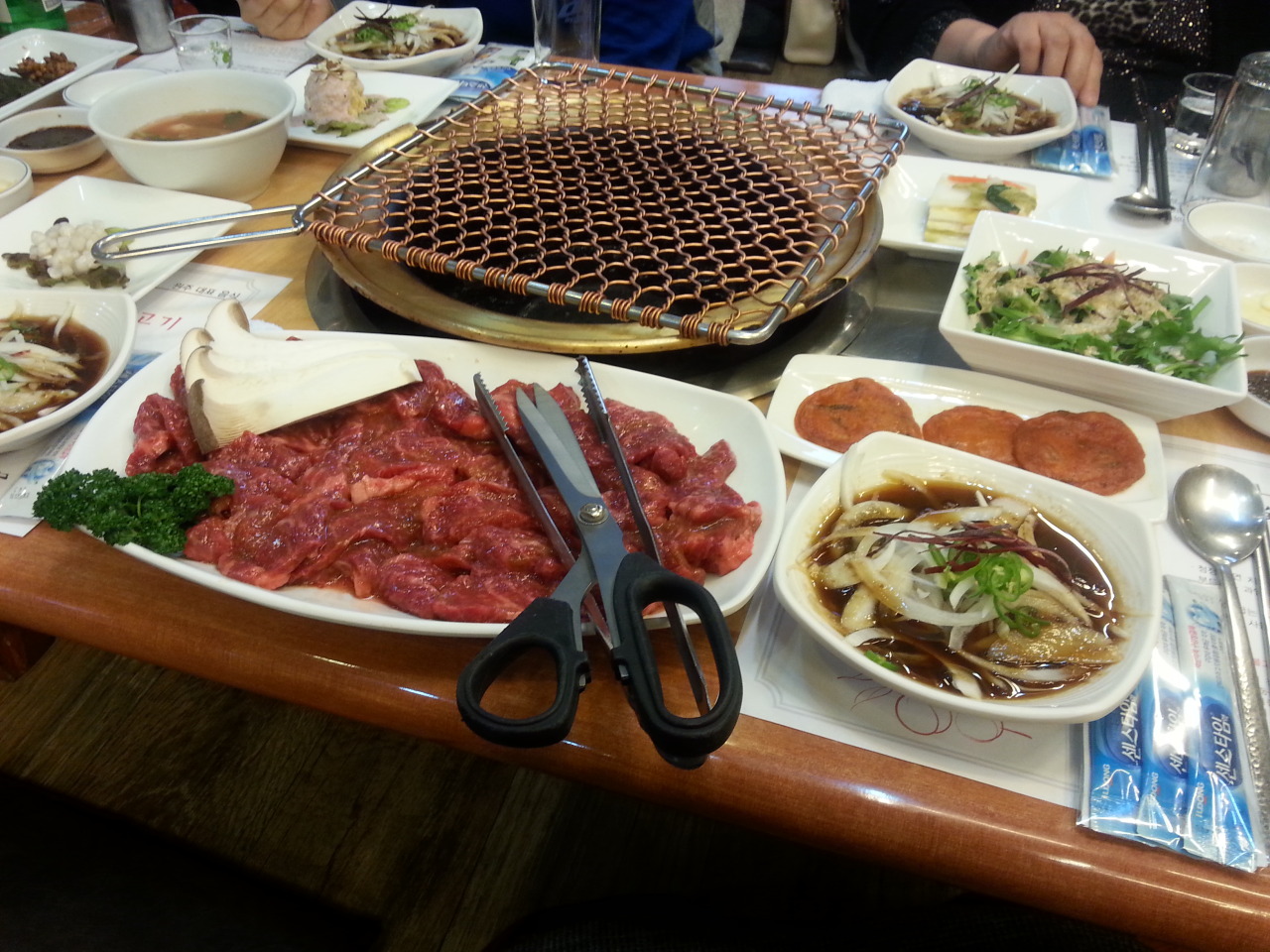
Bulgogi marinated in peach sauce, all on the company card.

It may sound like a pain, having to attend a work event outside of normal hours that you don't get paid for, but unless your coworkers are actually straight up mean to you, these things can be pretty fun. Even if you don't drink, it's a great chance to talk to different people and see a more relaxed side of the people you share a stuffy office with every day. Plus, free food.

Beyond the company dinners, always offer to help out with events. Odds are, you'll be assured that no, they don't need any help, but the mere fact that you offered means a lot. For instance, at the end of the school year, right around Christmas, there was a big school festival, with everything from an art show to various dance and music performances by students and teachers. I'd mentioned earlier in the year that I played the violin, but thought nothing of that fact until the music teacher approached me one day with the idea of us playing a duet at the festival. I was flattered, and thanks to his charming smile, I agreed.

The whole experience was really great. Even though the ladies in my office refused to let me help them with the setup, possibly because explaining what needed to be done to the clumsy foreigner was more trouble than it was worth, I still had something that drew me in to the spirit of the event. We practiced constantly, well aware that we had an audience of roughly 900 bored middle school students to impress. Despite my fears, the whole thing went off without a hitch, and 5 months later people still bring up my performance in conversation at lunch.

Anyways, that whole long ramble was just to illustrate my point; get involved! It won't suck, I promise! In fact, it usually ends up being really fun, even if you don't always know exactly what you're agreeing to participate in.

4. Go the extra mile


My explanations are getting shorter as my list gets longer. This one is pretty basic, and probably applies to jobs in any country, but I wanted my list to have 5 points, don't judge me.

If you're working in public school, I'm going to assume you're on a contract like me, which means that technically you only have to be in school from 8:30-4:30, and anything extra is overtime. "That's great!" you think, right? That means I can leave at 4:30 every day and have glorious long evenings all to myself.

Technically, this is true. However, most of your coworkers are likely going to be coming in earlier and/or staying later (whether or not this is a good practice is a debate for another time), and while I don't have any evidence to back this up, I imagine that seeing the young foreigner constantly arriving last and leaving first would not sit well.

So, my advice? Come in early once in a while. Stay a little late on days when you have a bit more to do, organize your classroom, chat over a cup of coffee with the person you sit next to, anything that strikes your fancy. If you're magically on top of your lesson plans, bring your Korean homework and do it at work!

I know this is probably controversial, since this is technically working overtime without getting paid for overtime, but let's be honest, will the odd half hour once or twice a week really kill you?

This also applies to helping out with stuff beyond teaching your classes. I've helped the IT guy understand difficult metaphors in Jason Mraz songs. I once read a speech aloud for a teacher's husband while he recorded me, so he could practice his English pronunciation before a big speech at his company. On a memorable day during Winter break, I teamed up with my office mates to rearrange and clean our entire office, much to the surprise of everyone who came in the next day.

5. Bring Food


Look, this one is really easy. Everyone likes food. Except people on diets maybe? But I'm not counting them because they secretly like food, they're just pretending they don't for the sake of health or beauty whatever. There's a rumor that my office is cursed; stay here long, and you're bound to gain weight, thanks to all the snacks everyone brings in.


The irresistible charm of eggplants.
Guaranteed to make you fat: baked sweet potatoes and rice cakes.
Seeing as I neither own a farm nor have a real kitchen, I usually go for an easier route. Seasonal fruit is always a safe bet. When mandarin oranges were cheap, I would grab a bag of those once a week or so, mostly out of a selfish desire to eat lots of tiny oranges, but it also meant that I had an office of people beholden to me for my generous citrusy benevolence. Honestly, you'd be amazed how far a small gesture can get you.

Guess which one is me?


So there they are, my 5 suggestions for getting along happily with your Korean coworkers. As I said before, I'm not a cultural expert, an expert on how to make friends, an expert on Korean schools...can you see a trend?

What I do know is that I consider many of my fellow teachers to be friends, and some even feel like family, so I must be doing something right.

Do you work in a Korean school? Any more tips for happy office relations? Think my advice is dumb? I'd love to hear from you in the comments~!